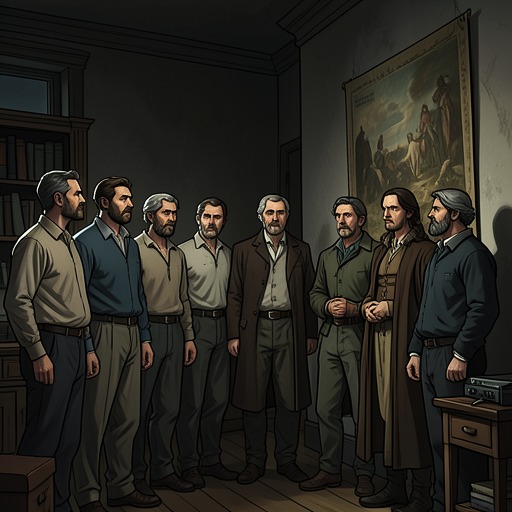
Antoni Fortuny
The Shadow of the WindAntoni Fortuny, known as the hatter, is a Barcelona craftsman whose pride in his profession coexists with emotional reserve and deepening bitterness. His relationship with his son, Julián Carax, deteriorates as Julián is drawn into the world of the Aldaya family and toward Penélope Aldaya. Years later, when Julián returns to Barcelona in danger and searching for Penélope, Fortuny protects him and searches for her himself. His arc moves from possessive resentment and estrangement to a belated, active devotion that cannot undo the losses separating father and son.
Identity and Background
Fortuny defines himself through his trade: he takes professional pride in being called a hatter and has difficulty speaking openly about feelings that do not concern hats. Sophie Carax first meets him while working as a music tutor in wealthy households. He courts her persistently, although she feels friendship rather than love for him and repeatedly refuses his proposals. Her loneliness and need for companionship lead her to continue seeing him, and she values the version of herself reflected in his admiring regard. For Fortuny, however, her affection never becomes the romantic love he seeks.
The two eventually marry, but the evidence presents their marriage as shaped more by Sophie’s loneliness and accommodation than by reciprocal passion. After Julián escapes to Paris, Sophie leaves Fortuny; years later she writes to him from Bogota, where she is living with another man. Their correspondence continues, and Fortuny tells Julián that they speak of him because he is the one bond they still share. Fortuny’s attachment to Sophie thus persists in altered form, bound to the son whose absence has become central to both their lives.
Estrangement from Julián
Fortuny’s initial pleasure at the new clientele brought by the Aldayas fades as Julián spends more time with the family and less with his parents and old neighborhood friends. Sophie expresses her disapproval quietly, through sadness and silence. Fortuny reacts more openly, with bitterness and spite. He complains that Julián imagines himself important because rich people treat him like a performing monkey, and he interprets his son’s distance as both abandonment and misplaced ambition.
As Fortuny’s shop and family life become sources of frustration, he directs his dissatisfaction toward those around him. He finds fault with Quimet, a local boy and former friend of Julián whom he hires as an apprentice, and with Sophie’s attempts to make light of Julián’s apparent rejection of them. His inability to speak directly about grief turns it into habitual criticism: the more distant his son becomes, the more harshly Fortuny judges him.
Confrontation with Don Ricardo
Almost three years after Don Ricardo Aldaya first visited the Fortuny and Sons hat shop, Fortuny leaves Quimet in charge and goes to the Aldaya consortium’s offices on Paseo de Gracia. He identifies himself to the clerk as Don Ricardo’s personal hatter and asks to see him. Fortuny has come not to discuss a bill but to discredit Julián in the eyes of the man whose approval and influence have drawn the young man away from home.
Fortuny describes his son as ignorant, lazy, mediocre, and without ambition or character, accusing him of pretending to know more than he does. He insists that Don Ricardo does not know the real Julián and presents his own familiarity as a reason to distrust him. Don Ricardo listens without interrupting, then dismisses Fortuny coldly and tells him not to return. Fortuny corrects him on the name, insisting that he is Fortuny, not Fortunato, but the correction does not alter the outcome.
The encounter deepens Fortuny’s isolation rather than restoring his influence. Within days, clients connected to the Aldayas cancel orders and settle their accounts; within weeks he has to dismiss Quimet because there is not enough work for both of them. The neighborhood notices that Fortuny looks older, lonelier, and more bitter. He spends long stretches alone in the shop, watching passers-by as the business declines amid changing fashions and competition from cheaper, ready-made hats. He privately imagines that others are waiting for him to die and says that, in a sense, he has already been dying for a long time. His personal disappointment and the shop’s commercial decline gather into the same image of a life slowly shutting down.
Plans for His Son
During Julián’s last year at San Gabriel's School, the other young men around him seem to have futures mapped out: Jorge Aldaya is expected to study in England, Miquel Moliner plans to attend Barcelona University, and Fernando Ramos is considering the Society of Jesus. Julián, uncertain about his literary ambitions and focused on being near Penélope, does not know that others are making plans on his behalf. Don Ricardo intends to place him in the family firm; Fortuny secretly plans to send him into compulsory military service, believing military life will cure what he regards as delusions of grandeur.
Fortuny’s decision is another expression of the conflict between his understanding of Julián and Julián’s own desires. He does not share the boy’s literary hopes and regards his independence as a refusal to accept ordinary responsibilities. Yet his effort to arrange a future for his son also shows that their separation is not simply indifference: Fortuny tries to direct Julián’s life, but does so without understanding or consulting him. By the time Julián discovers the plan, it is too late for him to shape the decision on equal terms.
Return, Protection, and Search
When Julián eventually returns to Barcelona, the hat shop is still open, but Fortuny has grown old, has lost his hair, and seems diminished behind the counter. Julián hesitates outside, not wanting to enter or reveal himself. Their eyes meet through the window. Fortuny recognizes his son, comes out without speaking, leads him inside, and lowers the metal grille before embracing him. The closed shop briefly becomes a refuge from the outside world that has kept them apart.
Fortuny tells Julián that the police have recently asked after him. Javier Fumero has described Julián as a wanted man and accused him of killing Jorge Aldaya in Paris, among other crimes. Fortuny had pretended to cooperate, but the request offended him; he had no intention of betraying his son. After the police leave, he goes to the cathedral chapel where he first met Sophie and prays for Julián’s safe return. Now that Julián is home, Fortuny warns him of the danger and offers to take care of whatever has brought him back while he hides in the apartment. He promises that Julián’s room remains his for as long as he needs it.
Julián explains that he has returned to find Penélope. Fortuny pledges to search for her and imagines helping the two of them escape somewhere safe, away from Fumero and the past. For days Julián stays in his old room while Fortuny searches the city. The room is unchanged: notebooks, pencils, books, and the clothes Julián left behind remain there, though time makes everything seem smaller. The preserved room gives tangible form to Fortuny’s continuing attachment to the son who once left it.
Change and Narrative Significance
Fortuny’s search brings him up against the collapse of the world he had once assumed wealth could preserve. He had believed money and social standing would endure, but years of ruin and destitution have erased the Aldaya mansions, industries, and even the dynasty’s recognizable presence from Barcelona. Many people still know the name, yet few remember what it once meant. Fortuny cannot find Penélope or her family, and the status that once drew Julián into their orbit offers no path back to her.
When Miquel Moliner and Nuria come to the shop asking after Julián, Fortuny mistakes them for Fumero’s agents and fears that his son will be taken from him again. His reaction reveals how completely the earlier separation has shaped his return to fatherhood: protection has become urgent and uncompromising. A flower vendor later remembers seeing him near the Aldaya mansion. What appeared to be suspicious prowling was Fortuny’s determined attempt to find some sign of Penélope and save his son from despair. He even directs his prayers toward that purpose, though he receives no answer.
The search fails. Fortuny tells Julián that he cannot find Penélope, and Julián answers that the task is his own and that his father has already helped as much as he could. The ending preserves both the intimacy of their reconciliation and its limit: Fortuny can offer shelter, loyalty, and a renewed effort to protect his son, but he cannot recover the woman Julián seeks or repair the years already lost. His significance lies in that reversal. The father who once tried to diminish Julián and plan his life for him becomes, at last, his defender, even when love cannot change the outcome.